Training-only robustness for bimanual VLA policies
Robust Bimanual Vision-Language-Action Models via Embarrassingly Simple Modality Masking
1Southeast University 2Shanghai Innovation Institute 3Wuhan University 4Zhejiang University 5University of Science and Technology of China 6Shanghai Jiao Tong University 7City University of Hong Kong
Takeaways
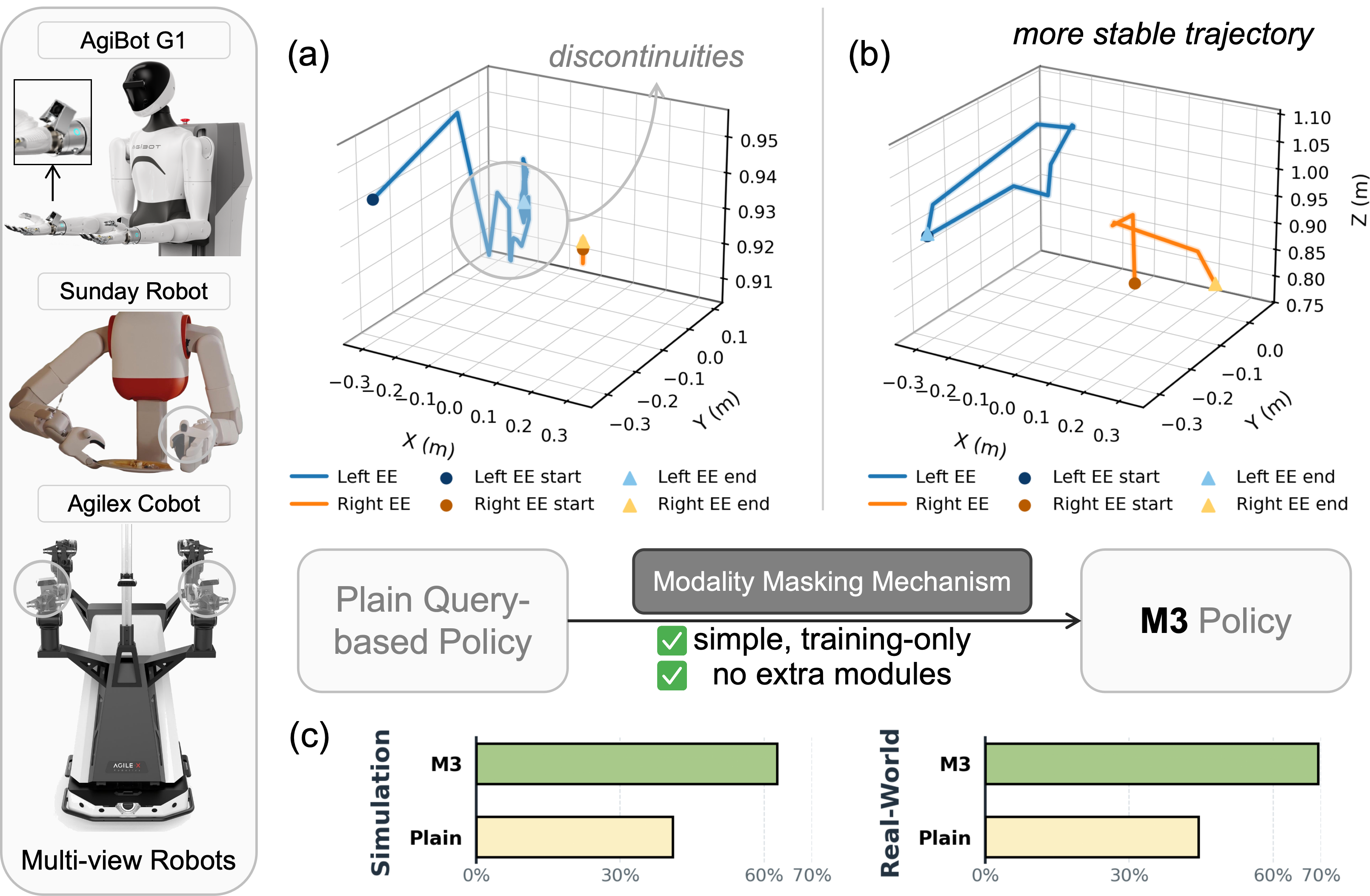
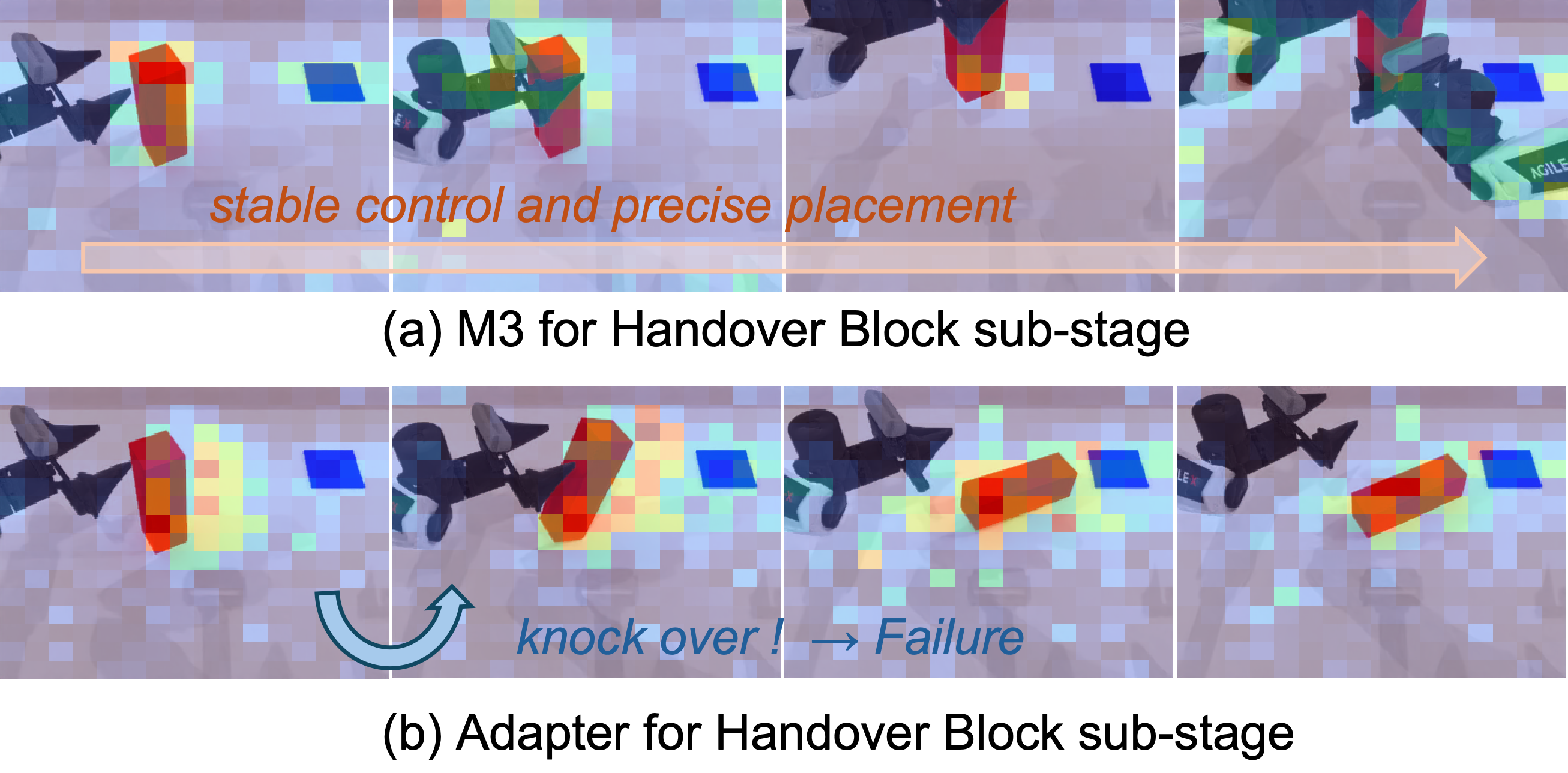
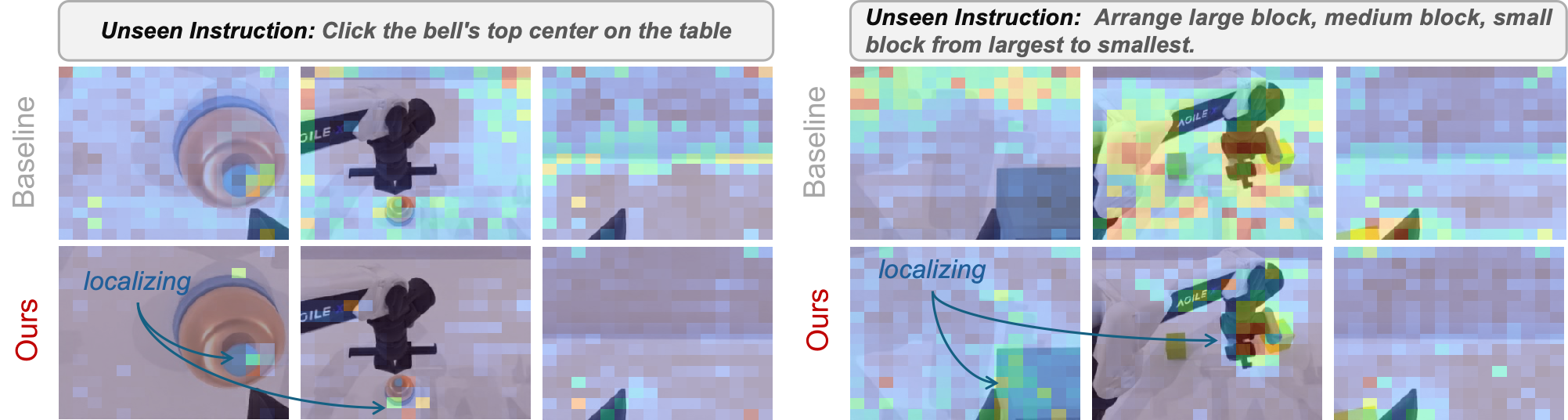
- Query-based VLA policies offer low-latency inference, but we observe discontinuous actions and execution failures in some complex dual-arm tasks, often alongside attention spreading to distracting regions.
- Modality Masking Mechanism (M3) is an embarrassingly simple, training-only intervention that masks structured subsets of wrist-view, language, and action-query tokens, with no inference-time architecture change.
- Within the evaluated RoboTwin 2.0 protocol, M3 improves average success over Adapter by +21.7 points (Clean) and +11.4 points (Clean2Rand).
- On one Agilex platform and three long-horizon tasks, the observed averaged full-task success is higher for M3 than for Adapter in both clean and OOD evaluations.
Abstract
Query-based Vision-Language-Action (VLA) models offer low-latency inference that is attractive for bimanual robotic manipulation, but we observe that they can still exhibit discontinuous actions and execution failures in complex dual-arm tasks. We hypothesize that unstable multi-view and language fusion is one contributing factor in these failures, often coinciding with attention spreading to distracting regions. To improve robustness, we introduce the Modality Masking Mechanism (M3), an embarrassingly simple, training-only strategy that requires no architectural changes or large-scale robot pretraining. M3 stochastically masks subsets of modality channels during training, exposing the policy to controlled partial observations and encouraging it to rely less on distracting cues and more on evidence that remains reliable. We evaluate M3 on ten bimanual tasks from RoboTwin 2.0 and on three long-horizon real-world tasks. Compared with the Adapter baseline, M3 improves average success by 21.7% in the Clean setting and 11.4% in Clean2Rand, where policies are trained on clean demonstrations and evaluated on randomized scenes, while also improving averaged real-world full-task success by over 30%. These results suggest that structured training-time masking is a practical way to improve the robustness of query-based VLA policies for bimanual manipulation.
Modality Masking Mechanism (M3)
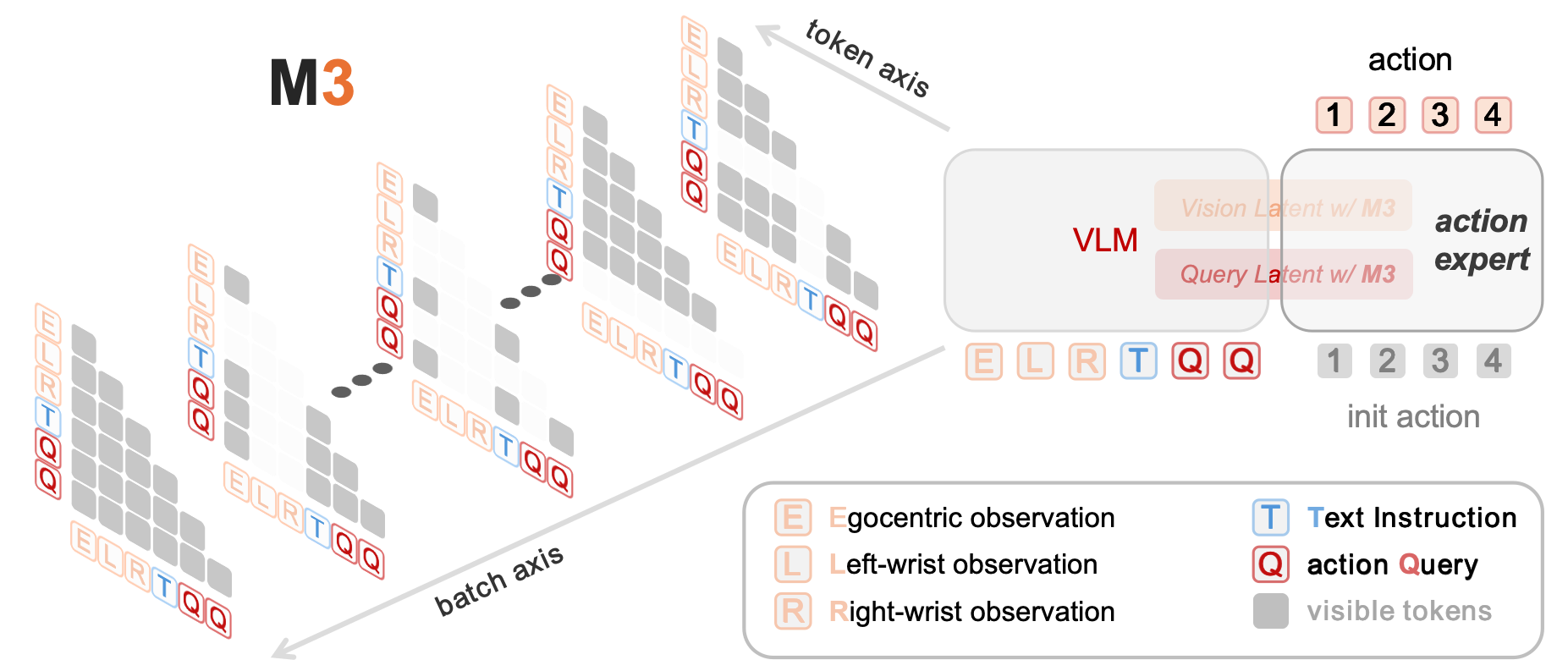
M3 trains query-based VLAs under controlled partial observability to reduce reliance on particular camera configurations and potentially distracting cues. Instead of always fusing every camera, language token, and query, we stochastically hide token subsets during training while keeping the inference-time architecture unchanged. The method follows three simple design guidelines:
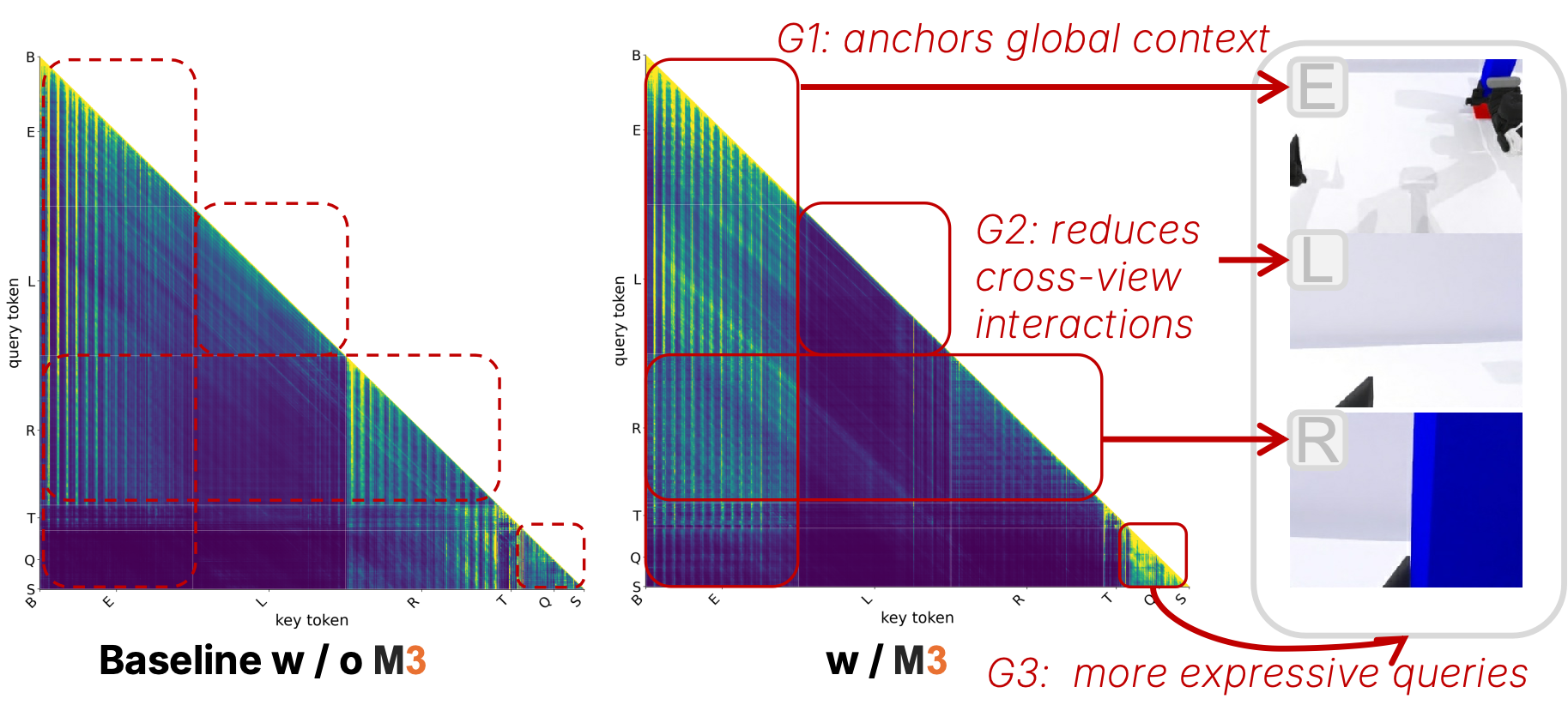
- Keep the egocentric view to retain global layout and long-range affordances.
- Mask arm-mounted views in pairs to decouple global (ego) and local (wrist) evidence and avoid spurious cross-view interactions.
- Mask only a subset of action queries, rescaling the visible ones so queries learn complementary specializations without losing all action context.
Concretely, a Bernoulli mask hides both wrist streams jointly, a second mask can hide the entire language modality, and an element-wise query mask always retains at least one active action query. The egocentric stream remains visible throughout training. A unified additive visibility mask is applied inside scaled dot-product attention, while visible queries are rescaled to preserve their expected magnitude. The policy keeps the standard L1 regression objective, and all modalities are restored at deployment.
Evidence & Analysis
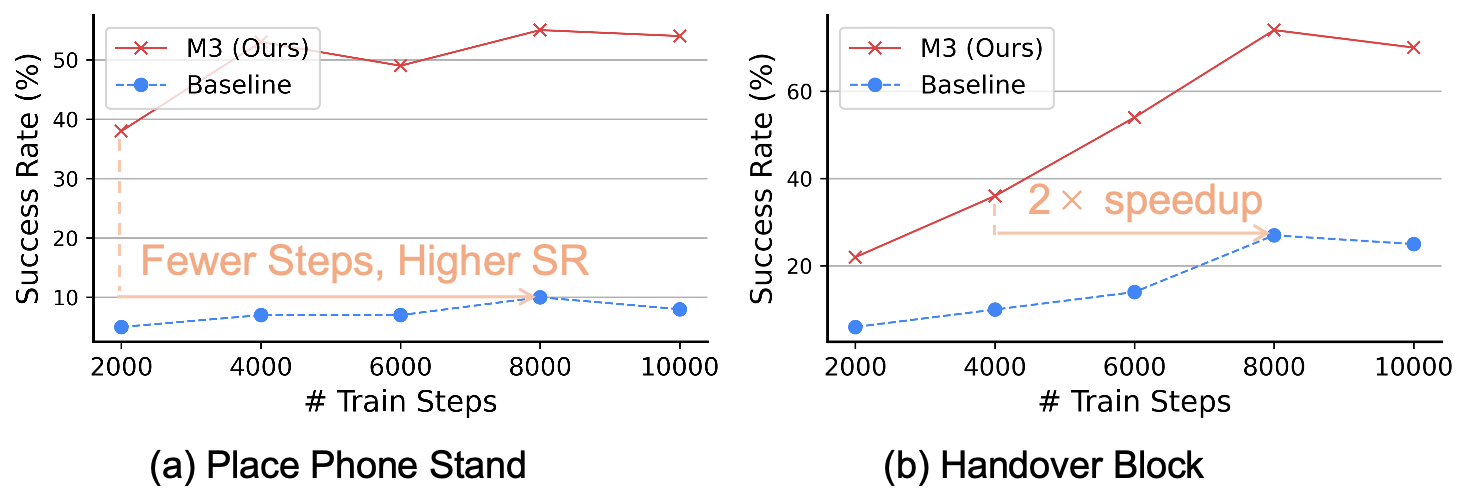
We test whether the observed gains extend beyond the primary Adapter backbone and examine post-hoc attention patterns, learning curves, and comparisons with standard regularization strategies. The analyses include one additional query-based backbone, representative attention maps, learning curves on two tasks, and regularization comparisons averaged over three tasks.
Cross-backbone transfer
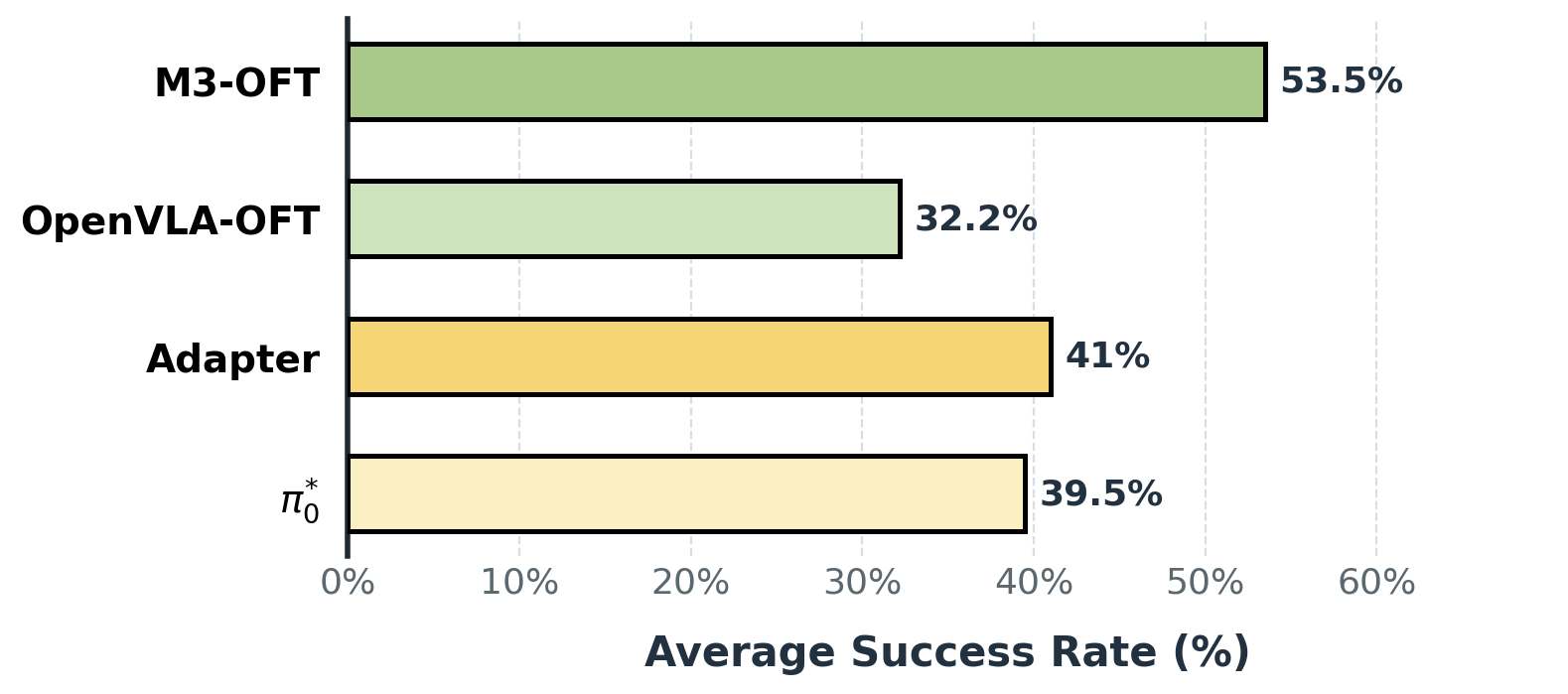
Domain-clean success rates (%) across the ten RoboTwin 2.0 tasks. Each +M3 column applies the same training strategy to the preceding backbone; ΔAdapter and ΔOFT report the corresponding gains over Adapter and OpenVLA-OFT. Bold and underlined values denote the best and second-best results in each row, respectively.
| Category | Task | Pretrained | Adapter | ΔAdapter | OpenVLA-OFT | ΔOFT | |||
|---|---|---|---|---|---|---|---|---|---|
| RDT* | π0* | Base | +M3 | Base | +M3 | ||||
| Short | Click Bell | 80 | 44 | 84 | 97 | +13 | 86 | 100 | +14 |
| Grab Roller | 74 | 96 | 88 | 96 | +8 | 94 | 97 | +3 | |
| Place Phone Stand | 15 | 35 | 10 | 55 | +45 | 24 | 56 | +32 | |
| Middle | Place Bread Basket | 10 | 17 | 11 | 22 | +11 | 3 | 13 | +10 |
| Place A2B Right | 1 | 27 | 4 | 28 | +24 | 8 | 10 | +2 | |
| Place Shoe | 35 | 28 | 34 | 63 | +29 | 17 | 50 | +33 | |
| Stack Blocks Two | 21 | 42 | 78 | 83 | +5 | 22 | 69 | +47 | |
| Long | Handover Block | 45 | 45 | 27 | 74 | +47 | 28 | 39 | +11 |
| Put Bottles Dustbin | 21 | 54 | 60 | 81 | +21 | 40 | 75 | +35 | |
| Block Rank Size | 0 | 7 | 14 | 28 | +14 | 0 | 26 | +26 | |
| Overall Avg | 30.2 | 39.5 | 41.0 | 62.7 | +21.7 | 32.2 | 53.5 | +21.3 | |
Structured masking vs. generic regularization
Average success rate (%) over Place Phone Stand, Place Shoe, and Handover Block. This reproduces the dropout and augmentation comparison in Table 4(b) of the paper.
| Method | Avg. SR |
|---|---|
| Adapter | 23.7 |
| Token dropout | 31.8 |
| Modality dropout | 24.1 |
| Visual augmentation | 22.3 |
| Region augmentation | 23.0 |
| Mask one wrist | 32.7 |
| M3 (full) | 64.0 |
Current scope. Broader evaluation across robot platforms, task categories, VLA architectures, richer geometric inputs, and diffusion-based action decoding remains future work.
Simulation Experiments
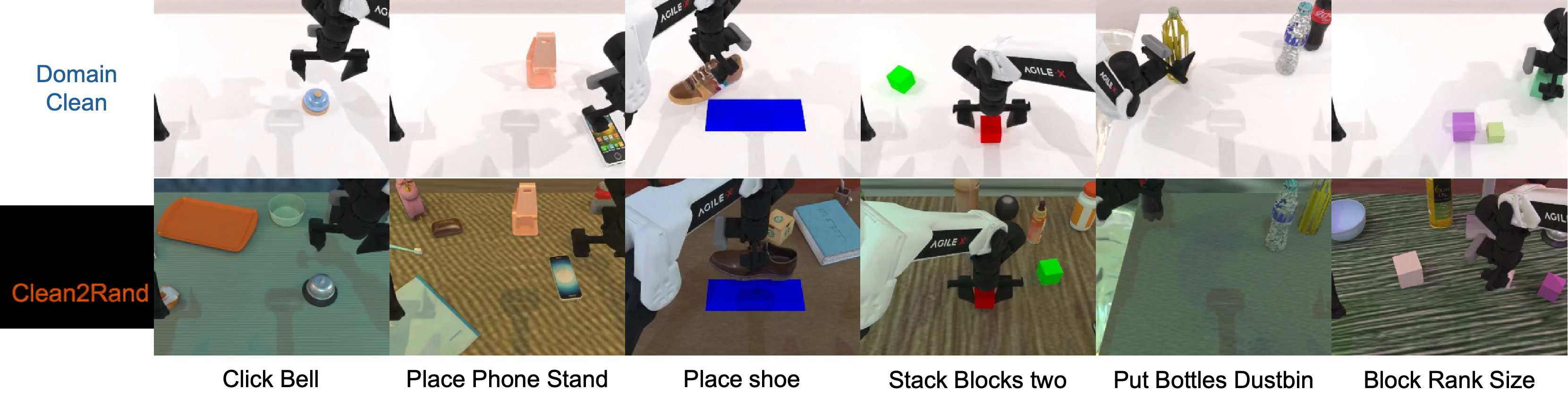
We use RoboTwin 2.0 as the primary simulation benchmark. It provides 50 dual-arm tasks with randomization over distractors, backgrounds, lighting, table height, and language instructions. Following the paper protocol, we select 10 tasks spanning short-, medium-, and long-horizon categories. Each task is trained on 50 clean demonstrations and evaluated on 100 held-out scenarios in two settings: Clean uses held-out clean scenes, while Clean2Rand evaluates the same clean-trained policy on held-out randomized scenes. The reported simulation results follow the official benchmark protocol and are single-run comparisons.
RoboTwin rollouts
The ten benchmark tasks are shown as direct, task-aligned comparisons. Each card plays the Adapter baseline beside M3 so differences in completion behavior can be inspected without switching views.
Real-World Evaluation
We evaluate three long-horizon tasks on an Agilex Cobot platform: Bottle Cleanup, Stack & Shelf, and Veggie Centering. Each task exceeds 800 control steps and uses 50 demonstrations. For every task and model, evaluation is repeated over three matched rounds, totaling 48 clean and 24 OOD evaluations per task.
In this evaluation, observed averaged full-task success is 44.4% for Adapter and 69.4% for M3 under clean conditions, and 12.5% versus 61.1% under the OOD protocol.
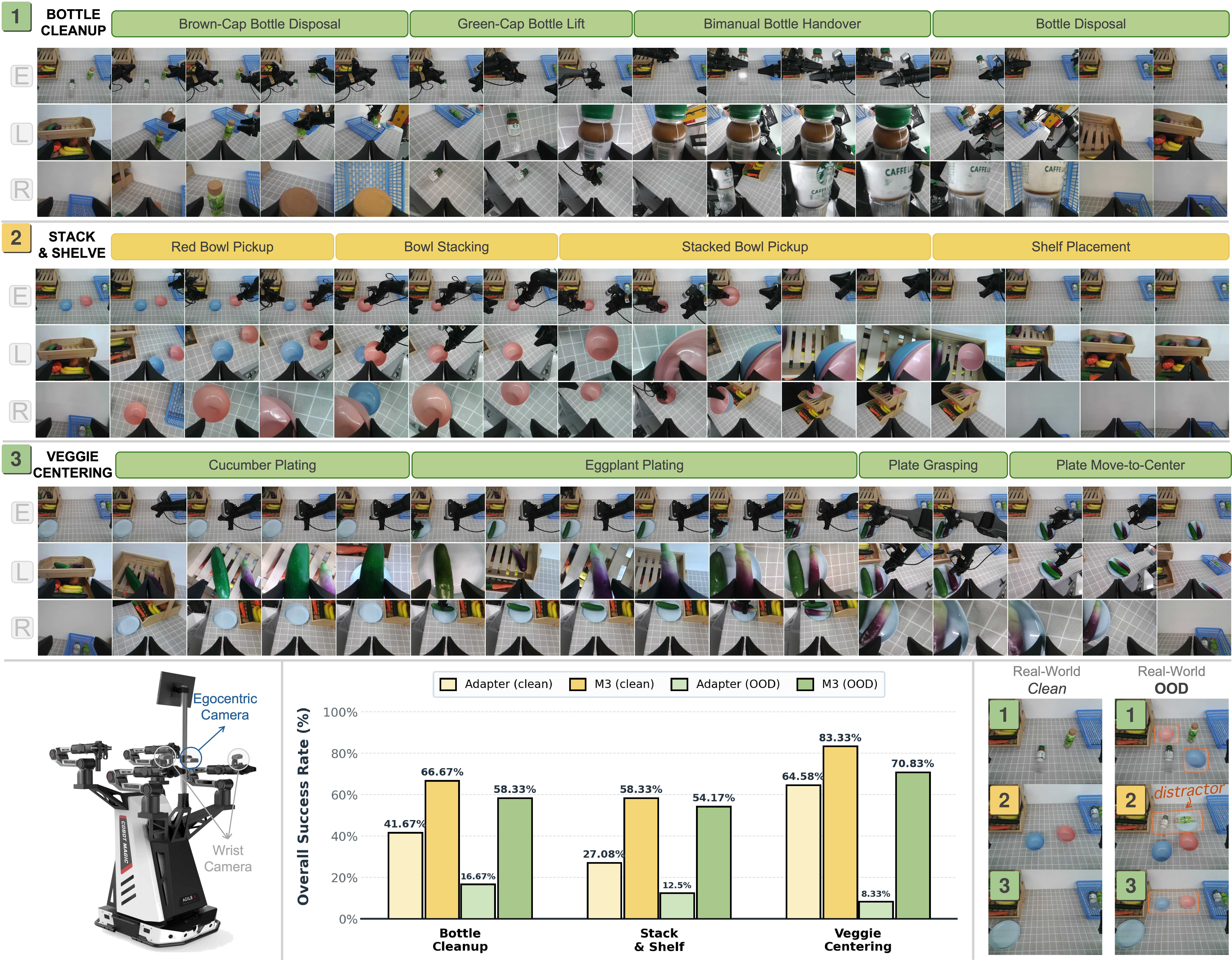
Case-aligned three-view rollouts
For each available matched case, Adapter and M3 are shown simultaneously. Rows identify the method; columns align the egocentric, left-wrist, and right-wrist camera streams.
Nine paired cases are presented below—three per task—with synchronized egocentric, left-wrist, and right-wrist views. The aggregate rates above summarize the full evaluation protocol.
Citation
@misc{cheng2026modalitymasking,
  title={Robust Bimanual Vision-Language-Action Models via Embarrassingly Simple Modality Masking},
  author={Cheng, Dongzhou and Li, Ziang and Zhou, Yixiao and Li, Haojuan and Zhang, Jinghao and Lei, Lei and Dong, Minjing and Gui, Jie and Wang, Jiaqi},
  year={2026},
  note={Preprint},
  url={https://m3vla.github.io/}
}